TAKING A LOOK INTO OUR FILES: High-school and college prep
As the end of my oldest student's eighth grade year aproaches, we've been thinking and talking more and more about plans for the future. This includes both high school plans, college plans, and beyond.
It's not really something new for us. You might be surprised if I told you how long I'd been thinking about this. But I knew this time would come and I don't think I'm really all that different than most people. I do wonder, though, how many parents like me actually have file folders for their research.
I've collected bits of information mainly for two reasons. First, we want to be prepared for the future. Second, I want to feel more prepared in the face of what feels like such a big and overwhelming phase for us.
Let's be honest, there's sometimes a lot of pressure on parents and students when contemplating what the future holds. The pressure can be even greater when it's the first time you've gone through all of this. But there are so many helpful, confident voices out there who have traveled this road before. And there is so much that we can learn from them!
I thought I'd share a list of the types of materials I have in my high-school and college prep idea files.
-A list of books I haven't read but want to read. Topics include life-lesson books like "How to Win Friends and Influence People", specific books and videos that might make up part of a high school course, scholarship books, etc.
-A list of books that colleges and "experts" have suggested that students read before graduating (we'll consider some of these when deciding what literature to read during the next few years)
-Articles torn out of magazines about everything you can imagine related to getting into college, parenting teens, how to write homeschool transcripts, and non-traditional activity ideas such as entrepreneurship
-A list of our state's graduation requirements
-A community college brochure (and one from a large high school) which lists their courses offered (as an idea-starter when deciding which courses we might like to pursue in high school)
-A list of college requirements from a few typical colleges, showing the items that we'll need in a few years when it's time to apply. Some of these include items that will need to be considered well ahead of time, such as letters of recommendation.
My file is already pretty sizable, but there are also a few categories we haven't started including yet: colleges that strike our fancy with contact information; testing deadlines for the PSAT, SAT, ACT. Also, scholarships and deadlines actually have their own folders.
Does anyone else keep a folder like this? What's in yours?
Showing posts with label Organization Station. Show all posts
Showing posts with label Organization Station. Show all posts
Friday, January 20, 2017

Thursday, April 7, 2011
Following Interests
It doesn't happen every week, but I do seek the kids' input on interests they might have. I have a box on my organization list (see pictures in the post below) to remind me to ask the kids what interests they'd like to pursue for the week (or weeks or months) to come. We look for library books on the topic or plan time to do related activities.
Dd5 had various horse topics on her list for a couple of weeks. Next week she'd like to learn how to take care of cats. (This is so that someday when she "grows up and lives next to me" she'll be prepared.)
Ds7 delved into chess for a while. Next week he'd like to learn about teeth. Who knew?
Tuesday, April 5, 2011
Organizing Our Weeks - A Template
I enjoy looking at the ways other people keep their days and weeks organized. I thought I would post a picture of my weekly system. It helps me to make sure that each subject is covered during the week a certain number of times. It also serves as my lesson plan book where I actually write which lessons we're doing.
I post these on the refrigerator and use a highlighter to color each box when the lesson is completed. It's great for the kids to see their progress toward finishing our weekly goals.


-I use this for my most structured weeks of the year. We also slip in a week of unit study, literature unit, or other out-of-the-ordinary weeks from time to time. I still use the template to try and cover these subjects during the unit.
-In the beginning, I made a note of which assignments were done independently and which needed to be done with me. That way I could sometimes offer a choice. "Which of these three with-Mom activities would you like to do first?"
-I try to have one working on independent activities while the other works with me.
-I've been trying to experiment with using workboxes and this helps plan out the week.
-I've experimented with having weeks where the kids got to choose to do their assignments in any order. The first couple times we did this ds7 ended up with three or four math assignments left for the last day. I thought it was fine as a learning opportunity, but it was a little much for him.
-One of the negatives is that I have to plan it all ahead of time (instead of getting away with planning a couple days and then planning the rest of the week later) but it's definitely one of the positives, too--lots of work in one day's planning, but more time later in the week for other things I have to do/like to do.
-As the kids have gotten older I've had the chance to ask for their input in the planning. For now it's been input into music, art, some of the science, character education, community goals, and general learning. I haven't experimented too much with letting them help set goals for the other subjects.
-We've also experimented with working ahead at the beginning of the week so that we have some extra time for something special at the end of the week. I think that would probably work out better as they get a little older.
-It's a little small but it saves paper (hello, frugality/get out the bifocals).
I post these on the refrigerator and use a highlighter to color each box when the lesson is completed. It's great for the kids to see their progress toward finishing our weekly goals.
These are the templates for ds7, grade 2.


This is the template for dd5, grade K.
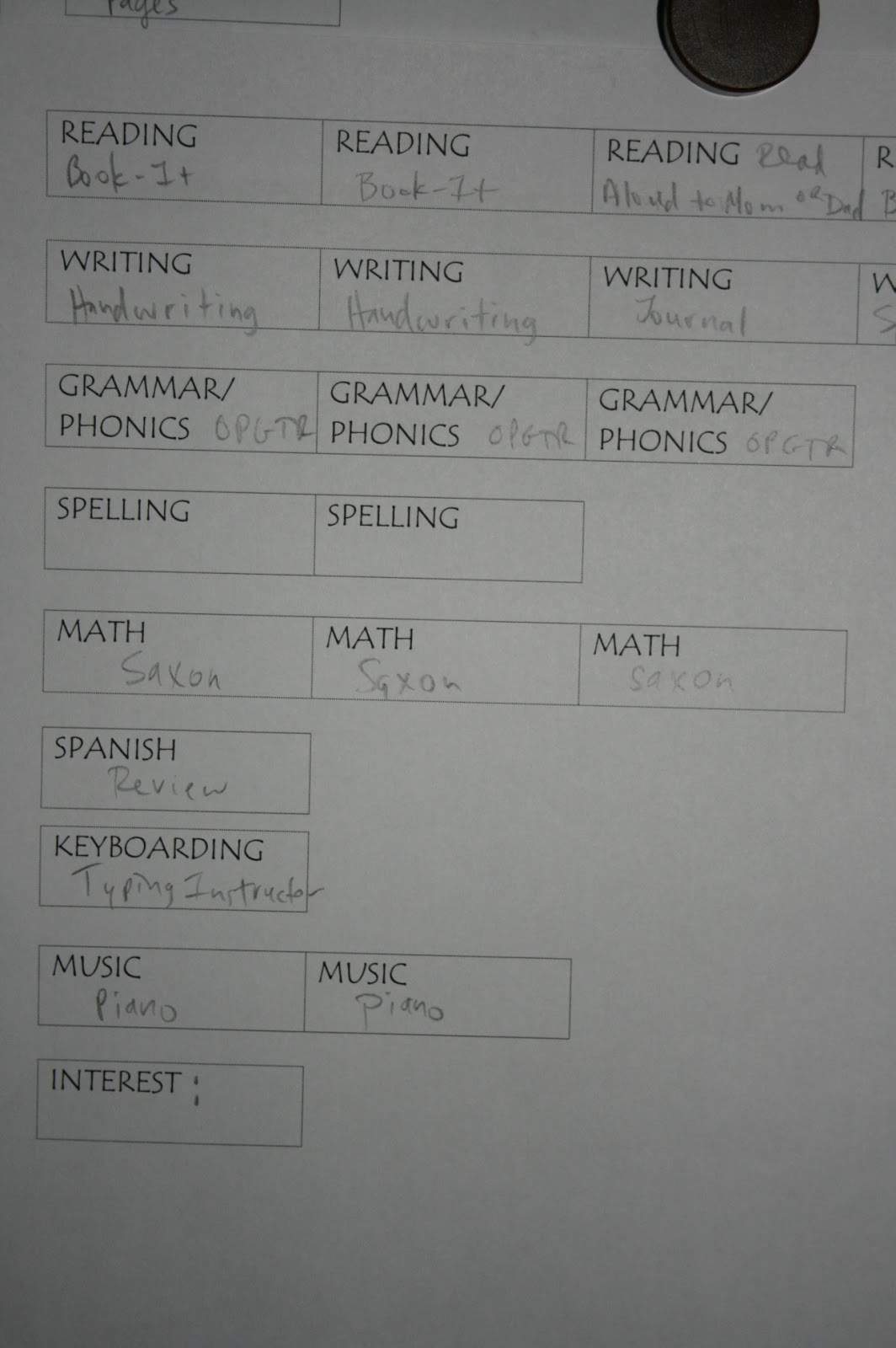
Notes:
-In the beginning, I made a note of which assignments were done independently and which needed to be done with me. That way I could sometimes offer a choice. "Which of these three with-Mom activities would you like to do first?"
-I try to have one working on independent activities while the other works with me.
-I've been trying to experiment with using workboxes and this helps plan out the week.
-I've experimented with having weeks where the kids got to choose to do their assignments in any order. The first couple times we did this ds7 ended up with three or four math assignments left for the last day. I thought it was fine as a learning opportunity, but it was a little much for him.
-One of the negatives is that I have to plan it all ahead of time (instead of getting away with planning a couple days and then planning the rest of the week later) but it's definitely one of the positives, too--lots of work in one day's planning, but more time later in the week for other things I have to do/like to do.
-As the kids have gotten older I've had the chance to ask for their input in the planning. For now it's been input into music, art, some of the science, character education, community goals, and general learning. I haven't experimented too much with letting them help set goals for the other subjects.
-We've also experimented with working ahead at the beginning of the week so that we have some extra time for something special at the end of the week. I think that would probably work out better as they get a little older.
-It's a little small but it saves paper (hello, frugality/get out the bifocals).
Of course, things change from time to time and we try to be flexible and open to that as well.
Sunday, March 13, 2011
Turn out the lights, the party's over
I've often been one to spend the last couple days of a vacation feeling a little sad to see it go. In my head I know it's silly--I'm still on vacation. Why waste the last moments because you're disappointed that they're over?
I'm trying to have a much better attitude this time around. After a nice week-long spring break it's time to get back to school. None of us are really itching to do it, but we all know it's time. After all, we only have about 40 school days left before a longer summer break.
Here's my plan for a successful first day back, and hopefully then, a great start to the rest of our year:
*Be clear about expecations.
-I've mentioned the end of break a couple of times so that it wouldn't come as a surprise.
-We'll talk after dinner tonight about getting back into the swing of things and put it in a positive light.
-I'll remind the kids where to go tomorrow morning to find their assignments (they'll be taped to the fridge).
*Have something to look forward to.
-When laying out tomorrow's assignments I've tried to plan a couple less "booky" subjects in addition to their more academic subjects to ease back into schooltime.
-I'll plan an extra family movie night for something to look forward to. (We usually do movie night on Fridays.) It's a good reminder that we "work while we work so we can also play while we play".
*Be patient, be patient, be patient.
-I'll remember to do my deep breathing and you remember to do yours. After all, one of our reasons for homeschooling is to develop a strong family relationship. We're in
this together. Time flies. We're going to enjoy each other while we can.
Wednesday, March 9, 2011
Cleaning Up a Little at a Time
At the beginning of the year I made a pact with myself. I have a lot of things in my basement (and various nooks upstairs) that need to be gone through. I'm sure a lot of things could be thrown out.
Since our monthly garbage bill is the same whether my trash can is half-empty or completely full, I made a goal to try to get my money's worth. I've been trying to have a full can each week. If there is a bag's worth of room in the can on the night before trash day, I've been trying to go through something that could be thrown away.
So far this plan has worked out pretty well. Most weeks the can is pretty full. I've probably gotten rid of at least 4 or 5 bags of trash that otherwise may not have been gotten to yet. It's also a good time to review those school "projects" still "adorning" our home. Is it time to take a photo and toss the original project? After all, how long does it take before salt-dough castles start to attract unwanted visitors?
Saturday, March 5, 2011
When the cat's away, what will the mice do?
Do you leave "lesson plans" for your "substitute"?
I was going to be away for a couple of days this week. I left my husband in charge of the kids. I didn't leave instructions for any schoolwork other than a packet full of worksheets intended more to keep them busy on the morning he had to take them to work with him.
I returned from my retreat refreshed and renewed...and completely surprised.
Not only had the kids done very thorough, neat work on the worksheets, he had also taken them through a writer's workshop and part of a mini-unit he found (by himself) at theoldschoolhousestore.com.
It was a good reminder that it can be very beneficial for both the kids and me to find someone that loves a particular subject and would be willing to mentor them in that subject. My husband is so good at writing and the kids did a really nice job in their writer's workshop. What a nice surprise.
(The sink was completely empty of dishes, too!) :)
Staying on Track
What do you do to stay "on track" when things are crazy around the house?
One way I accomplish this is to buy a "complete" workbook each year. (I usually purchase the grade level above what my kids would be in school since they're working above grade level in most subjects.) I've been really pleased with Scholastic Success With 3rd Grade this year. Language arts, reading, math, and map work are all covered in pretty good detail.
If we're ever traveling to a far-away field trip or things are just too crazy to plan "regular" subjects I pull this out and feel my sanity returning with every moment.
What do you do to stay "on track"?
Sunday, September 19, 2010
Keeping Track of Items While Traveling
Taking a Minute to Take Inventory
Whenever we go to visit friends for a playdate, visit family, or take toys and learning activities on a trip, I like to know that we've got everything before we return home. I give each child a ziploc or cloth bag for their items. We count the number of items in the bag and then we label the bag with a tag showing that number. It works well when we take games or other "sets" of things along with us, too.
Wednesday, September 8, 2010
How We Structure Our School Days-Time
Since my kids tend to thrive on the predictable, we try to keep a basic structure on school days. The subjects change but the time spent doing schoolwork tends to stay largely the same.
A typical day starts between 8:15 and 8:30 with a short task. It's usually something that the kids can accomplish mostly on their own while I get breakfast ready. This gets us thinking in "school" mode. It also gives us the chance to "cross something off our list".
I usually try to teach one of the subjects we do together (religion, science, history) while they eat breakfast. It's often something they listen to and then we discuss. They're a captive audience and we're together anyway.
After breakfast we'll do any writing or activities that accompany the breakfast lesson.
Then we'll usually split up for one-on-one subjects. I'll assign one child to a "center" activity, folder work, or something on the computer that can be completed with little or no help from me. The other child and I will work on a subject like math, language arts, or handwriting that is best done without outside interruption. After I'm done with one child I'll switch and work with the other.
Depending on the day, this is a good time for a little break. I try to gauge this based on the intensity of the work already completed or whether any of us seem to have a real need for it at this point.
Some days we'll also come back together for a "morning meeting" which is another subject we do together. I try to make this subject something less academic, since at this point we've already put in a significant amount of time working. Playing Spanish vocabulary bingo, doing an art project, or reading together fit this theme.
After this, the kids enjoy a well-deserved break. Someday I'll figure out how to squeeze a break in here for myself, too. For now I'm usually cleaning up, putting away the morning's tidbits, and making lunch.
There are often a few assignments leftover for the afternoon. These are usually accomplished without too much complaint, since they are followed by free time. It's also the time of day we'll watch any videos that would accompany one of our academic subjects.
I'm a big fan of active, physical, (hopefully) outdoor time. We all try to get out as a family each day in the evenings. (Besides the health benefits, the obvious benefit is having kids who are tired enough to get to sleep at a decent time!) We also like to squeeze some active time in during the school day.
I'll address the questions of "What are we doing today?" and "Are we done yet?" in another post.
Monday, August 30, 2010
How We Structure Our Year
We currently live in a state that does not have a law regarding the number of days or hours that we homeschool.
Still, it seems helpful to me to know that we're not trying to fit in "too much" or doing "too little".
Every spring, I use a calendar to map out a 180 school-day calendar.
Last year I actually wrote down which days we would be doing school, knowing that it wasn't absolutely set in stone (family things come up, kids get sick...). We actually stuck to it pretty well, beginning August 1 and ending May 19. It was a good plan.
This year we're trying something a little different. I did short review (often fun review) sessions throughout the summer to keep the kids current on their skills. I counted these toward their new 180-day school year (so I guess this year we technically are doing school year-round). I wrote down only how many days per month we would be doing school. It works out to about 4 days per week.
Each year I also try to map out the materials we'll be using for each school subject as well as how many days per week we should be doing them.
Our subject areas this year include Reading, Writing, Grammar, Phonics, Vocabulary, Other Language Arts, Math, History, Science, Religion, Logic, Art, Music, Dance/Theater, PE, Computers/Keyboarding, Latin, Spanish, Life Skills/Character Education, Community-Based Learning, and Hobby/Interest Areas.
Subscribe to:
Posts (Atom)